International Pilot License
Earned a Federation Aeronautique Internationale license in France in 1921, the first for an African American woman.
1892–1926
Aviator • Pioneer • Trailblazer
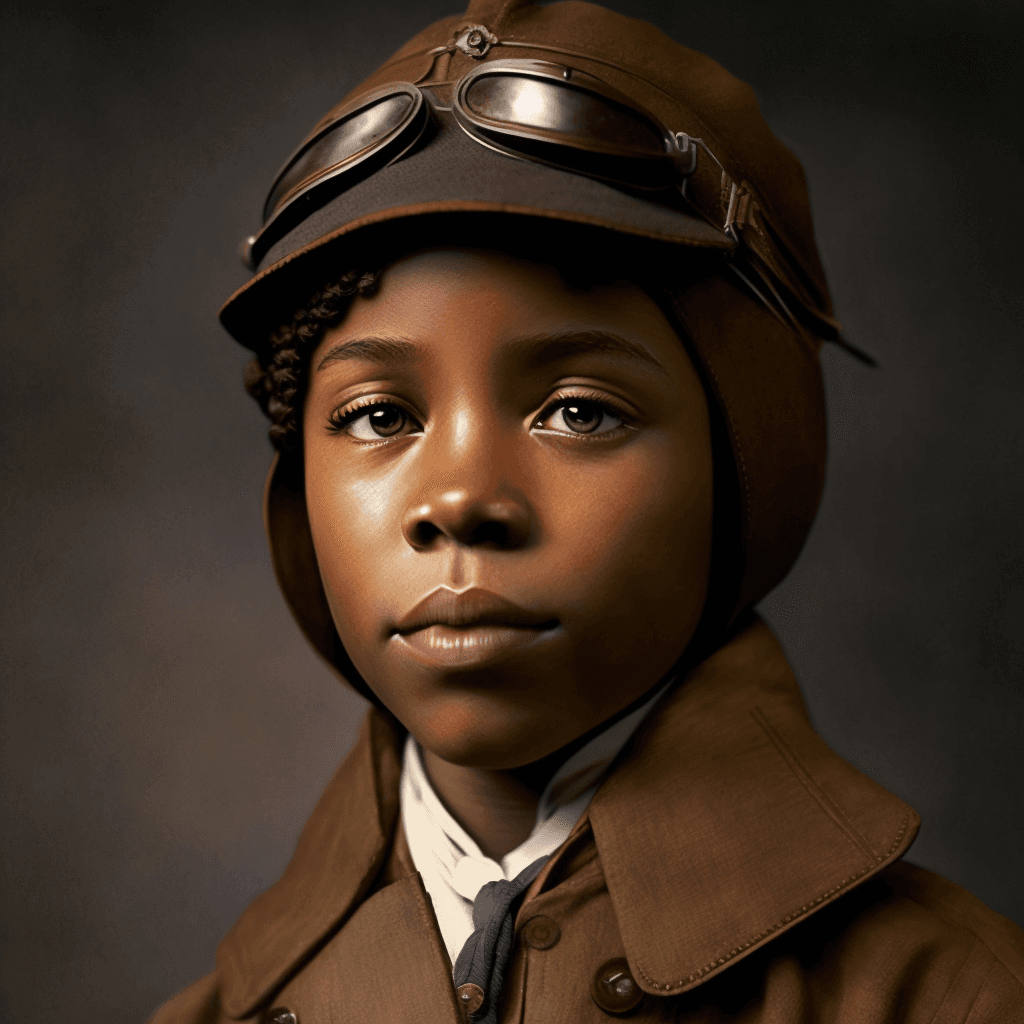
Bessie Coleman was born on 26 January 1892 in Atlanta, Texas, one of thirteen children in a sharecropping family of African American and Native American descent, in a region where Jim Crow law and economic exploitation structured daily life. Her father George Coleman, of Cherokee heritage, left for Indian Territory in 1901 seeking better opportunity, while mother Susan raised children with cotton field labor and domestic work. Bessie walked four miles to a segregated one-room school, excelling in mathematics and reading while balancing chores that limited formal study. In 1915 she moved to Chicago during the Great Migration, joining siblings in the city's South Side and working as a manicurist at the White Sox Barber Shop on 35th Street. There she heard stories from veterans and pilots returning from World War I about aviation, a field that seemed to symbolize modern freedom yet remained closed to Black women in American flight schools. Every U.S. aviation program Coleman approached rejected her on the basis of race and gender; newspapers and mentors including Robert S. Abbott, publisher of the Chicago Defender, encouraged looking abroad. Coleman saved money from beauty work and restaurant jobs, studied French at a Chicago language school, and secured sponsorship from Abbott and Jesse Binga, a prominent Black banker. Her determination reflected broader Migration-era ambition: Chicago offered political organizations, press networks, and a community that funded talented individuals barred from white institutions. Leaving for France in November 1920, she carried not only personal dreams but representational weight as first Black woman seeking licensure in an era when flight itself was front-page news.
Coleman trained at the Caudron brothers' aviation school at Le Crotoy on the Somme, then at Fédération Aéronautique Internationale accredited institutions near Paris, enduring cold open cockpits and rudimentary controls. French instructors and fellow students, less encumbered by American segregation, judged her on skill; she completed advanced coursework in stunt flying and parachute technique uncommon for civilian pilots. On 15 June 1921 she received FAI pilot license number 6013 from the Fédération Aéronautique Internationale, predating Amelia Earhart's license and making Coleman the first Black woman aviator in documented history. Returning to the United States in 1921, she discovered fame did not erase barriers: commercial airlines and military aviation remained closed, so she built a barnstorming career at air shows across the South and Midwest. Performances included loop-the-loops, figure eights, and parachute drops from Curtiss JN-4 Jennies, drawing interracial crowds when promoters allowed integrated seating. Coleman refused to perform at venues that segregated Black spectators or relegated them to distant fields, insisting on equal access and using contract leverage when possible. She lectured in churches and schools about aviation and racial uplift, dreaming of opening a flight school for African Americans where none existed domestically. Media coverage alternated between admiration for her skill and racist caricature; she cultivated elegant public presentation— leather jacket, boots, poise—to counter stereotypes. In Los Angeles a crash during publicity filming in 1923 broke bones and delayed her career, yet she returned to training and performance within a year.
Coleman's life ended on 30 April 1926 during a test flight in Jacksonville, Florida, with mechanic William Wills at controls; a wrench left unsecured in the engine compartment caused mechanical failure and the plane inverted, throwing her without parachute. She was thirty-four; memorial services in Jacksonville and Chicago drew thousands, and Abbott's Defender eulogized her as a race pioneer. Though her career spanned only five public years after licensure, Coleman shattered barriers in a field dominated by white men and inspired later pilots including William J. Powell, who cited her in Black Wings campaigns, and the Tuskegee Airmen generation. Astronaut Mae Jemison acknowledged Coleman as predecessor; the U.S. Mint issued a quarter bearing her image in 2023. Her annual birthday is recognized in some states as Bessie Coleman Day, and Chicago O'Hare's international terminal displays her history. Historians emphasize how American racism exported its limits even into new technologies like flight, forcing transnational pursuit of training. By achieving licensure abroad and returning as performer, she made aviation visible to Black communities and challenged Jim Crow norms in entertainment contracts. Her story widens imagined boundaries of who could master the sky and continues to inspire campaigns for diversity in STEM and aerospace. Coleman's French training also illustrates global circuits of knowledge that bypassed domestic exclusion long before civil rights legislation. She remains a touchstone for courage, pragmatism, and the cost of being first when institutions refuse to accommodate talent on equal terms. Aviation museums display Jennies she flew and oral histories from nieces preserving family memory of her discipline and humor. Federal Aviation Administration educational materials cite Coleman when discussing exclusion and international credentialing pathways. Historians of gender and technology compare her barnstorming contracts with male pilots' earnings, documenting economic as well as social barriers in 1920s entertainment aviation.
1892 — Born in Texas. Born in Atlanta, Texas, and raised in a large sharecropping family.
1915 — Moved to Chicago. Relocated during the Great Migration and worked in the city's South Side.
1920 — Training in France. Traveled to France to train at the Caudron school after U.S. rejections.
1921 — License Earned. Received her international pilot's license on June 15, 1921.
1926 — Fatal Test Flight. Died in Jacksonville, Florida, during a rehearsal for an air show.
Key moments across this figure's life and legacy
1892
Born in Atlanta, Texas, and raised in a large sharecropping family.
1915
Relocated during the Great Migration and worked in the city's South Side.
1920
Traveled to France to train at the Caudron school after U.S. rejections.
1921
Received her international pilot's license on June 15, 1921.
1926
Died in Jacksonville, Florida, during a rehearsal for an air show.
Landmarks that define this figure's contribution to history
Earned a Federation Aeronautique Internationale license in France in 1921, the first for an African American woman.
Performed aerobatic exhibitions across the United States, drawing interracial audiences to aviation.
Refused to fly at events that barred Black spectators from equal seating.
Lectured on flight and planned a school to train African American pilots before her death.
Notable details about this historical figure
How this figure shaped the world we inherit
Coleman's path through France exposed how American racism exported its limits even into new technologies like flight. By achieving licensure abroad and returning as a public performer, she made aviation visible to Black communities and challenged Jim Crow norms in entertainment. Her example widened the imagined boundaries of who could master the sky and continues to inspire campaigns for diversity in STEM and aerospace.
Enduring influence across generations
Coleman's path through France exposed how American racism exported its limits even into new technologies like flight. By achieving licensure abroad and returning as a public performer, she made aviation visible to Black communities and challenged Jim Crow norms in entertainment. Her example widened the imagined boundaries of who could master the sky and continues to inspire campaigns for diversity in STEM and aerospace. Fatal Test Flight (1926) remains a defining moment in Bessie Coleman's enduring reputation.
Explore more profiles from the same era or field
Curated educational resources for further study
Start a private conversation and explore their wisdom through Historical Collection AI.