Laws of Motion
Three principles forming the foundation of classical mechanics and engineering.
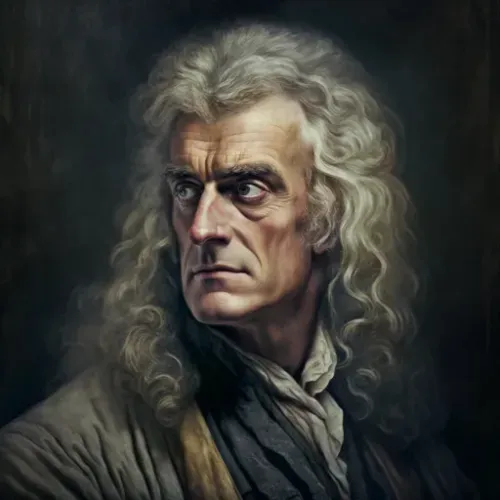
1643–1727
Mathematician • Physicist • Astronomer
Isaac Newton was born in Woolsthorpe, England, amid the turmoil of civil war and the Scientific Revolution. A solitary and intensely focused student, he entered Cambridge University and later weathered the plague years by developing the foundations of calculus and conducting experiments on light. His genius combined mathematical abstraction with a conviction that nature's laws could be read through observation and measurement.
In 1687 he published Philosophiæ Naturalis Principia Mathematica, presenting three laws of motion and the law of universal gravitation. The Principia showed that the same force governing an apple's fall also governs the Moon's orbit, unifying terrestrial and celestial mechanics. Newton's work on optics demonstrated that white light comprises a spectrum of colors, challenging prevailing theories.
Knighted and appointed Master of the Mint, Newton also pursued alchemy and theology—fields that reveal the breadth of his inquiries. Though later physicists revised his framework, especially at extreme speeds and scales, Newtonian mechanics became the bedrock of engineering, astronomy, and Enlightenment thought, earning him a place among history's most influential minds.
1643 — Born in Woolsthorpe. Born prematurely in Lincolnshire; his father died before his birth.
1665–1666 — Annus Mirabilis. During plague closures, advanced calculus, optics, and gravitation ideas.
1687 — Principia Published. Released Mathematical Principles of Natural Philosophy, reshaping science.
1704 — Opticks. Published major work on light, color, and experimental method.
1727 — Death in London. Buried in Westminster Abbey as a national hero of the Enlightenment.
Key moments across this figure's life and legacy
1643
Born prematurely in Lincolnshire; his father died before his birth.
1665–1666
During plague closures, advanced calculus, optics, and gravitation ideas.
1687
Released Mathematical Principles of Natural Philosophy, reshaping science.
1704
Published major work on light, color, and experimental method.
1727
Buried in Westminster Abbey as a national hero of the Enlightenment.
Landmarks that define this figure's contribution to history
Three principles forming the foundation of classical mechanics and engineering.
Showed that all masses attract one another, explaining planetary orbits and tides.
Developed infinitesimal calculus independently, enabling modern mathematical physics.
Landmark 1687 treatise that systematized natural philosophy for generations.
Notable details about this historical figure
How this figure shaped the world we inherit
Newton's synthesis of mathematics and physics gave the Enlightenment a model of a rational, law-governed universe. Engineers built the Industrial Revolution on his mechanics; astronomers mapped the solar system with his gravitation; philosophers cited him as proof that human reason could decode nature. Even after Einstein, Newton remains essential for most everyday science—from bridge design to spaceflight trajectories.
Enduring influence across generations
Newton's synthesis of mathematics and physics gave the Enlightenment a model of a rational, law-governed universe. Engineers built the Industrial Revolution on his mechanics; astronomers mapped the solar system with his gravitation; philosophers cited him as proof that human reason could decode nature. Even after Einstein, Newton remains essential for most everyday science—from bridge design to spaceflight trajectories. Death in London (1727) remains a defining moment in Isaac Newton's enduring reputation.
Explore more profiles from the same era or field
Curated educational resources for further study
Start a private conversation and explore their wisdom through Historical Collection AI.