Revitalized American Conservatism
Aligned tax cuts, deregulation, and social traditionalism into a durable political coalition that dominated Republican politics for decades.
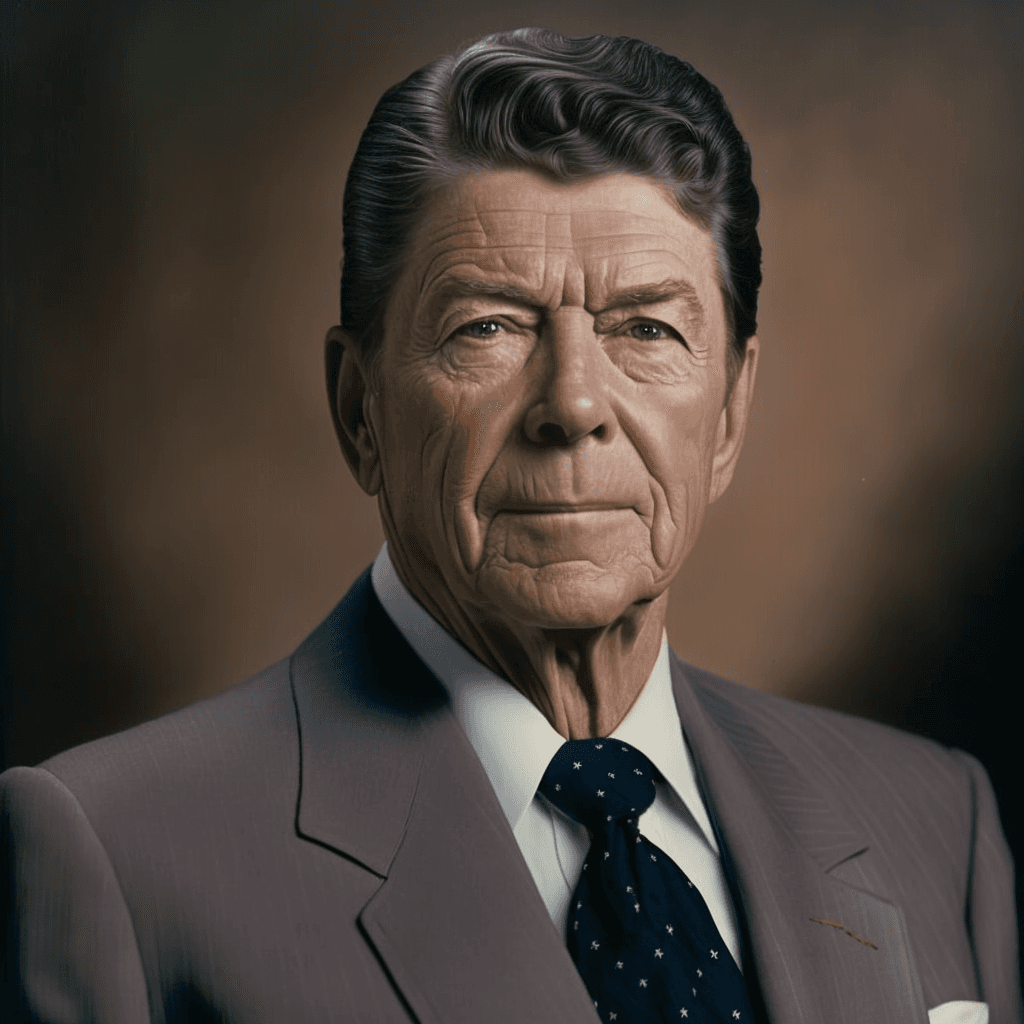
1911–2004
40th U.S. President • Statesman
Born in 1911 in Tampico, Illinois, Ronald Wilson Reagan worked as a radio announcer and Hollywood actor before becoming president of the Screen Actors Guild and shifting from New Deal Democrat to conservative Republican. Elected governor of California in 1966, he challenged campus unrest and expanded state government while building a national political base.
Reagan won the presidency in 1980 amid economic stagnation and the Iran hostage crisis, promising to restore American strength. His first term brought tax cuts, deregulation, and a defense spending surge; the 1981 assassination attempt barely slowed his agenda. In foreign policy he labeled the Soviet Union an 'evil empire' yet opened serious arms-reduction talks with Gorbachev after 1985.
The Reagan era saw the 1986 tax reform, appointment of conservative judges, and the Iran-Contra scandal, which damaged his second term but did not lead to removal from office. After leaving Washington, Reagan's 1994 Alzheimer's announcement prompted national reflection on a presidency that reshaped American conservatism and global anti-communist strategy.
1911 — Born in Tampico, Illinois. Raised in small Midwestern towns before attending Eureka College and pursuing radio and film careers.
1966 — Elected California Governor. Defeated incumbent Pat Brown, positioning himself as a national spokesman for conservative governance.
1981 — Inaugurated as 40th President. Took office promising morning in America; survived assassination attempt in March of the same year.
1987 — Signs INF Treaty. Joined Gorbachev in Washington to eliminate intermediate-range nuclear forces, a landmark Cold War agreement.
2004 — Death at 93. State funeral in Washington honored a president whose communication skills and ideological clarity reshaped American politics.
Key moments across this figure's life and legacy
1911
Raised in small Midwestern towns before attending Eureka College and pursuing radio and film careers.
1966
Defeated incumbent Pat Brown, positioning himself as a national spokesman for conservative governance.
1981
Took office promising morning in America; survived assassination attempt in March of the same year.
1987
Joined Gorbachev in Washington to eliminate intermediate-range nuclear forces, a landmark Cold War agreement.
2004
State funeral in Washington honored a president whose communication skills and ideological clarity reshaped American politics.
Landmarks that define this figure's contribution to history
Aligned tax cuts, deregulation, and social traditionalism into a durable political coalition that dominated Republican politics for decades.
Negotiated with Gorbachev toward the 1987 INF Treaty, eliminating an entire class of intermediate-range nuclear missiles.
Increased defense spending and modernization programs that shifted Cold War dynamics in the 1980s.
Signed bipartisan legislation lowering top income tax rates while broadening the base, the most significant tax overhaul in a generation.
Notable details about this historical figure
How this figure shaped the world we inherit
Reagan's presidency accelerated the shift toward free-market economics in the West and strengthened anti-Soviet pressure during the Cold War's final chapter. His rhetorical style and policy mix influenced leaders from Margaret Thatcher to later generations of conservatives, while debates over inequality and military spending trace directly to choices made in the 1980s.
Enduring influence across generations
Reagan's presidency accelerated the shift toward free-market economics in the West and strengthened anti-Soviet pressure during the Cold War's final chapter. His rhetorical style and policy mix influenced leaders from Margaret Thatcher to later generations of conservatives, while debates over inequality and military spending trace directly to choices made in the 1980s. Death at 93 (2004) remains a defining moment in Ronald Reagan's enduring reputation.
Explore more profiles from the same era or field
Curated educational resources for further study
Start a private conversation and explore their wisdom through Historical Collection AI.