On the Waterfront
Brando's Terry Malloy—'I coulda been a contender'—won the Academy Award and exemplified method acting on film.
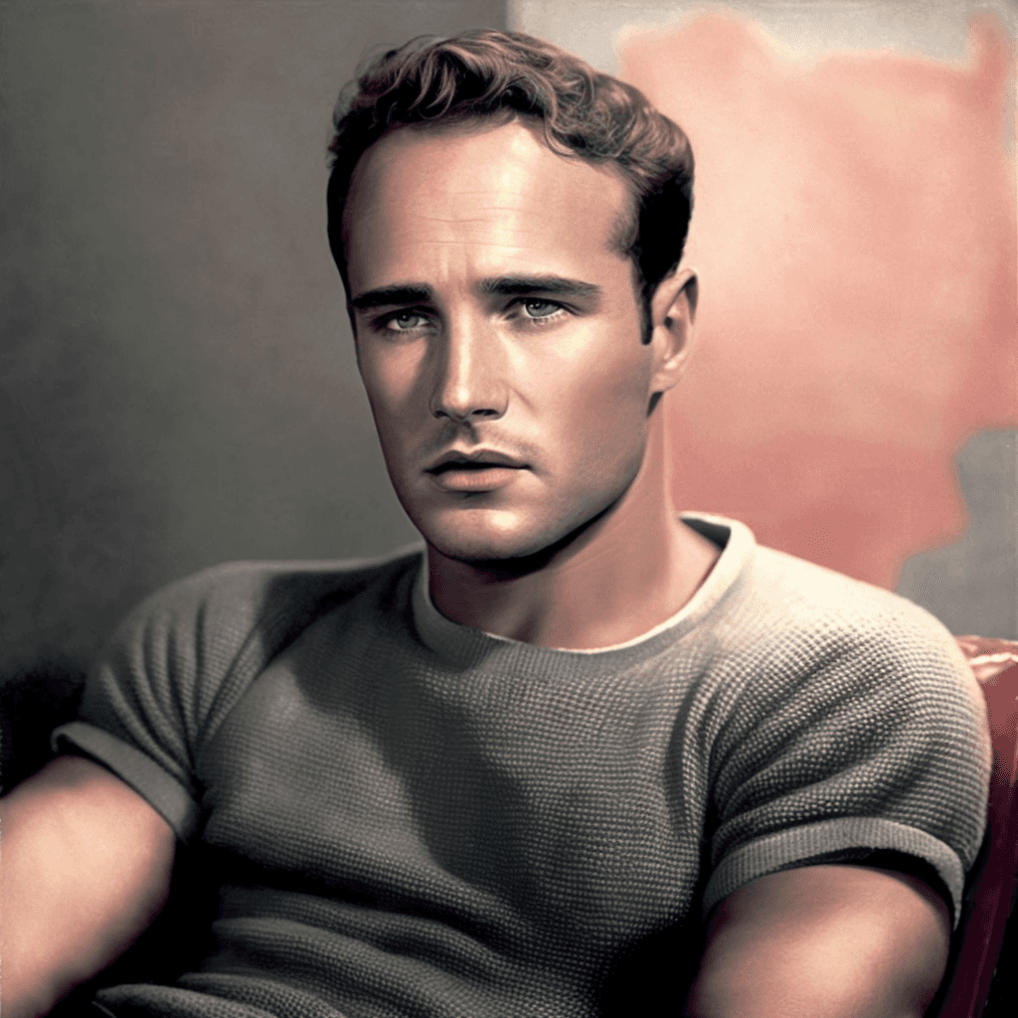
1924–2004
Actor • Method Acting Pioneer
Marlon Brando est né en 1924 à Omaha, Nebraska, de parents alcooliques ; il a été élevé en partie dans l'Illinois. Après son expulsion d'une académie militaire, il a étudié avec Stella Adler à New York et a rejoint l'Actors Studio, où la formation par la méthode mettait l'accent sur la mémoire, le sens et le sous-texte. Sa performance à Broadway en tant que Stanley Kowalski dans Un tramway nommé Désir (1947) a choqué le public par son réalisme musclé.
La célébrité à Hollywood a suivi. Brando a été acclamé dans Les Hommes, Un tramway nommé Désir (1951) et Sur les quais (1954), où son interprétation de l'éveil moral de Terry Malloy est devenue un modèle pour le jeu d'acteur moderne. Il a remporté un deuxième Oscar pour Le Parrain (1972) en tant que Vito Corleone, mais a envoyé l'activiste Sacheen Littlefeather pour refuser le prix en signe de protestation contre le traitement des Amérindiens par Hollywood. Ses rôles ultérieurs dans Dernier Tango à Paris et Apocalypse Now ont affiché à la fois brillance et controverse.
La politique de Brando, ses fluctuations de poids et son caractère reclus ont alimenté la légende des tabloïds, mais des générations d'acteurs citent son exemple. Il est mort en 2004 à Los Angeles, ayant transformé la performance d'un style déclamatoire à une vérité intérieure et incarnée.
Moments clés de la vie et de l'héritage de cette figure
1924
Brando grew up in the Midwest before moving to New York to pursue acting against his father's wishes.
1947
His Stanley Kowalski opposite Jessica Tandy's Blanche DuBois electrified theater critics and ticket sales.
1954
Brando won his first Academy Award for playing a dockworker who testifies against corrupt union bosses.
1973
He declined the Godfather award and sent Littlefeather to protest Native American portrayals in film and at Wounded Knee.
2004
Brando died at eighty from respiratory failure, mourned as one of cinema's most transformative performers.
Jalons qui définissent la contribution de cette figure à l'histoire
Brando's Terry Malloy—'I coulda been a contender'—won the Academy Award and exemplified method acting on film.
His quiet, physical portrayal of Vito Corleone redefined the gangster genre and earned a second Oscar for Best Actor.
As Stanley Kowalski on stage and screen, he brought Stanislavski-based realism to mass audiences.
Training with Adler and the Actors Studio, Brando made naturalistic performance the dominant standard in American theater and cinema.
Détails notables sur cette figure
Comment cette figure a façonné le monde que nous avons hérité
Brando a déplacé le jeu d'acteur au cinéma d'une élocution polie à un comportement psychologiquement ancré, influençant des interprètes allant de James Dean à Daniel Day-Lewis. Sa carrière a également croisé l'activisme pour les droits civiques et les attentes changeantes concernant la vie privée des célébrités.
Influence durable à travers les générations
Brando shifted film acting from polished elocution to psychologically grounded behavior, influencing performers from James Dean to Daniel Day-Lewis. His career also intersected with civil rights activism and changing expectations of celebrity privacy. Death in Los Angeles (2004) remains a defining moment in Marlon Brando's enduring reputation.
D'autres profils de la même époque ou du même domaine
Ressources éducatives sélectionnées pour approfondir
Entamez une conversation privée via Historical Collection AI.