On the Origin of Species
Published the 1859 work presenting natural selection as the mechanism of evolutionary change.
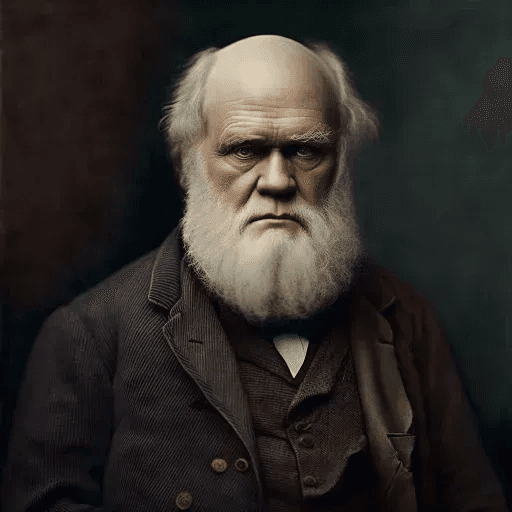
1809–1882
Naturalist • Evolution Theorist
Charles Robert Darwin was born on 12 February 1809 in Shrewsbury, Shropshire, England, into a prosperous family of physicians and Wedgwood pottery industrialists, with grandfathers Erasmus Darwin and Josiah Wedgwood embodying Enlightenment scientific and commercial culture. Charles's mother Susannah died when he was eight; father Robert, a successful doctor, hoped Charles would enter medicine or clergy, paths that seemed respectable for a younger son with modest academic enthusiasm at Shrewsbury School. He studied medicine at University of Edinburgh, repelled by surgery without anesthesia, then enrolled at Christ's College, Cambridge, intending Anglican ordination while preferring beetle collecting, geology outings with Adam Sedgwick, and mentorship by botanist John Stevens Henslow. Cambridge friendships and reading of Alexander von Humboldt and Charles Lyell prepared intellectual habits of careful observation and gradualist geological thinking. Henslow recommended Darwin as gentleman's companion-naturalist aboard HMS Beagle for 1831–1836 voyage despite Robert Darwin's initial objections to prolonged absence. Captain Robert FitzRoy sought educated dinner companion to stave off melancholy on multi-year survey mission mapping coasts of South America and circumnavigating globe. Darwin suffered seasickness yet collected specimens, fossils, and notes across Galapagos, Patagonia, Brazil, and Pacific islands, sending shipments to Henslow and geologists in England. Finch varieties, giant tortoise shells, marine iguanas, and fossil megafauna in Argentina raised questions about geographical variation and extinction that would mature into evolutionary theory. Return to England in 1836 made Darwin a rising figure in scientific societies though he published extensively on geology and barnacles before revealing species transformation views publicly.
Darwin married Emma Wedgwood, his cousin, in 1839; they settled at Down House in Kent, raising ten children while Charles worked amid chronic illness—palpitations, gastric distress, possibly anxiety or Chagas-related symptoms debated by medical historians. At Down he conducted breeding experiments with pigeons, consulted animal and plant breeders, corresponded globally with naturalists, and amassed notebooks outlining natural selection—variation, inheritance, competition, differential survival—by 1838, influenced also by Thomas Malthus on population pressure. Aware of controversial implications for religion and human uniqueness, Darwin delayed publication, refining evidence while writing bestselling Journal of Researches and monographs on coral reefs and volcanic islands. In 1858 Alfred Russel Wallace sent essay from Malay Archipelago presenting parallel mechanism of species change; Charles Lyell and Joseph Hooker arranged joint presentation at Linnean Society on 1 July 1858, preserving Darwin's priority while acknowledging Wallace. Darwin completed On the Origin of Species by Means of Natural Selection, published 24 November 1859 in John Murray edition that sold out quickly and underwent multiple revised editions responding to critics. Origin argued common descent explained anatomical homologies, fossil sequences, embryological similarities, and biogeographic patterns with elegant economy, avoiding explicit human evolution in first edition yet implying it. Debates with Richard Owen over anatomy, with Samuel Wilberforce at Oxford 1860, and with critics demanding missing transitional fossils occupied Darwin's correspondence network defended by Thomas Henry Huxley, nicknamed Darwin's bulldog. Darwin later applied evolution to human descent in The Descent of Man and Selection in Relation to Sex 1871 and studied orchid pollination, earthworm soil formation, and Expression of the Emotions in Man and Animals, demonstrating selection's breadth.
Darwin died on 19 April 1882 at Down House; despite initial plan for local burial, scientific colleagues arranged interment in Westminster Abbey, signaling national esteem and Anglican compromise. Twentieth-century genetics merged Mendelian inheritance with Darwinian selection in modern evolutionary synthesis, making evolution biology's central organizing principle from molecular to ecological scales. Medicine relies on evolutionary reasoning for antibiotic resistance, viral mutation, and comparative genomics; agriculture applies selection in crop and livestock breeding consciously echoing Darwin's observations. Social and religious responses sparked enduring debates over human place in nature, science education, and scriptural interpretation, especially in United States school board controversies. Darwin avoided public atheism; Emma's faith and his own theistic evolutionist language in early editions complicate simplistic conflict narratives. Statues, banknotes, and Darwin Day commemorations mark global scientific heritage; Galapagos tourism economy rests partly on his name. Historians note his abolitionist family ties and critique of slavery in Voyage narratives alongside Victorian racial blind spots in Descent of Man that later science rejected. Digital publication of Darwin's complete correspondence allows fine-grained study of collaborative Victorian science. Conservation biology uses evolutionary theory to predict extinction risks and design reserves. Darwin supplied a natural mechanism for life's diversity without recourse to separate acts of creation, reorganizing biology around history and change and reshaping medicine, ecology, anthropology, and public understanding of humanity's kinship with all living organisms. Natural history museums worldwide display Beagle voyage specimens with QR-linked Darwin correspondence explaining collection context. Evolution education standards in multiple countries still reference Origin chapter structure when designing curricula on variation and selection. Genomic sequencing of Darwin's finch descendants in Galapagos provides real-time demonstrations of selection pressures he inferred from morphology alone. Down House, preserved by English Heritage, welcomes visitors tracing his garden experiments and family life beside scientific work.
1809 — Born in Shrewsbury. Born in Shropshire into the Darwin-Wedgwood families.
1831 — Beagle Departure. Embarked on a five-year circumnavigation as ship naturalist under Captain Robert FitzRoy.
1859 — Origin of Species. Published On the Origin of Species after decades of private study.
1871 — Descent of Man. Released a work applying evolution to human ancestry and behavior.
1882 — Death and Abbey Burial. Died at Down House and was buried in Westminster Abbey.
Key moments across this figure's life and legacy
1809
Born in Shropshire into the Darwin-Wedgwood families.
1831
Embarked on a five-year circumnavigation as ship naturalist under Captain Robert FitzRoy.
1859
Published On the Origin of Species after decades of private study.
1871
Released a work applying evolution to human ancestry and behavior.
1882
Died at Down House and was buried in Westminster Abbey.
Landmarks that define this figure's contribution to history
Published the 1859 work presenting natural selection as the mechanism of evolutionary change.
Collected geological and biological data across five years that underpinned his theories.
Extended evolutionary theory to human origins and sexual selection.
Built an international exchange of specimens and observations supporting collaborative natural history.
Notable details about this historical figure
How this figure shaped the world we inherit
Darwin supplied a natural mechanism for life's diversity without recourse to separate acts of creation, reorganizing biology around history and change. Medicine, agriculture, and conservation now rely on evolutionary principles from antibiotic resistance to crop breeding. Social and religious responses to his work sparked enduring debates over human place in nature, science education, and the limits of scriptural interpretation in modern societies.
Enduring influence across generations
Darwin supplied a natural mechanism for life's diversity without recourse to separate acts of creation, reorganizing biology around history and change. Medicine, agriculture, and conservation now rely on evolutionary principles from antibiotic resistance to crop breeding. Social and religious responses to his work sparked enduring debates over human place in nature, science education, and the limits of scriptural interpretation in modern societies. Death and Abbey Burial (1882) remains a defining moment in Charles Darwin's enduring reputation.
Explore more profiles from the same era or field
Curated educational resources for further study
Start a private conversation and explore their wisdom through Historical Collection AI.