Amarna Co-Rulership
As Akhenaten's principal queen, Nefertiti appeared prominently in temple reliefs and may have shared governing authority during the Aten cult.
c. 1370–1330 BC
Queen • Icon of Ancient Egypt
Nefertiti was the Great Royal Wife of Pharaoh Akhenaten, who ruled Egypt around 1353–1336 BC during the New Kingdom. Her name means 'the beautiful one has come.' Together they moved the court from Thebes to a new capital, Akhetaten (Amarna), and promoted worship of the sun disk Aten above the traditional pantheon—a brief but radical theological shift in Egyptian history.
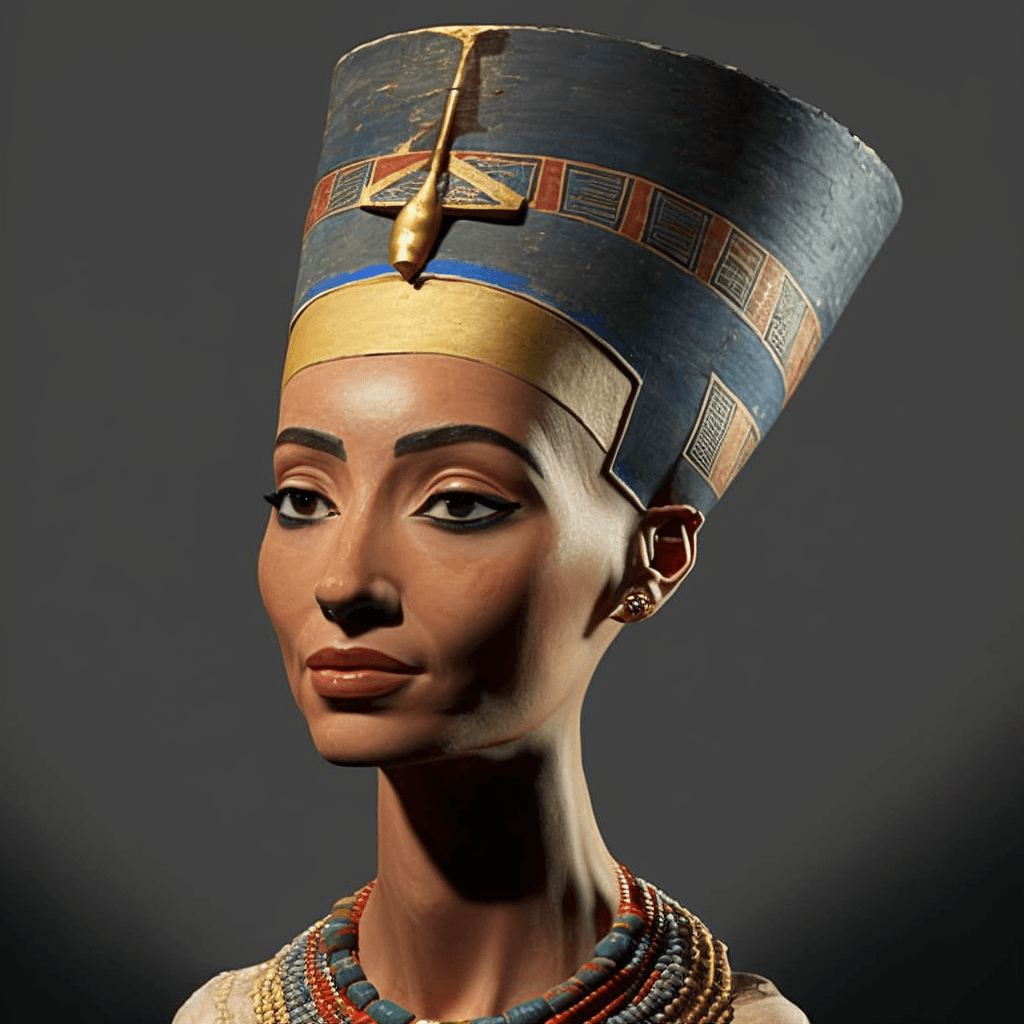
Art from Amarna depicts Nefertiti with elongated features and regal bearing, often beside Akhenaten and their daughters under the rays of Aten. She may have wielded significant political influence; some scholars suggest she served as co-regent or even briefly as pharaoh after Akhenaten's death under the name Neferneferuaten, though evidence remains contested. Her fate after the Amarna period is unknown; the court returned to traditional gods under Tutankhamun.
The painted limestone bust discovered in 1912 at Amarna by German archaeologist Ludwig Borchardt became a global icon of ancient beauty. Whether read as propaganda or portraiture, Nefertiti embodies the artistic and religious experimentation of Akhenaten's reign.
c. 1370 BC — Royal Marriage. Nefertiti became Great Royal Wife of Amenhotep IV, who later took the name Akhenaten.
c. 1345 BC — Founding of Akhetaten. The royal couple established a new capital dedicated to the sun god Aten in Middle Egypt.
c. 1340 BC — Peak of Amarna Art. Temples and tombs at Amarna depicted the royal family worshipping Aten in intimate, revolutionary styles.
1912 — Bust Excavated. Ludwig Borchardt's team uncovered the painted bust in the workshop of sculptor Thutmose at Amarna.
Key moments across this figure's life and legacy
c. 1370 BC
Nefertiti became Great Royal Wife of Amenhotep IV, who later took the name Akhenaten.
c. 1345 BC
The royal couple established a new capital dedicated to the sun god Aten in Middle Egypt.
c. 1340 BC
Temples and tombs at Amarna depicted the royal family worshipping Aten in intimate, revolutionary styles.
1912
Ludwig Borchardt's team uncovered the painted bust in the workshop of sculptor Thutmose at Amarna.
Landmarks that define this figure's contribution to history
As Akhenaten's principal queen, Nefertiti appeared prominently in temple reliefs and may have shared governing authority during the Aten cult.
She participated in the shift toward monotheistic solar worship that temporarily displaced Egypt's traditional priesthoods.
Sculptors under her court developed naturalistic, family-centered imagery distinct from earlier rigid royal portraiture.
The 1912 Berlin bust, with its symmetrical face and blue crown, became one of the most reproduced artifacts of antiquity.
Notable details about this historical figure
How this figure shaped the world we inherit
Nefertiti's image anchors public fascination with Akhenaten's religious experiment and the artistic freedom of the Amarna period. Debates over her political role and disappearance illustrate how Egyptology reconstructs women's power from fragmentary inscriptions and sculpture.
Enduring influence across generations
Nefertiti's image anchors public fascination with Akhenaten's religious experiment and the artistic freedom of the Amarna period. Debates over her political role and disappearance illustrate how Egyptology reconstructs women's power from fragmentary inscriptions and sculpture. Bust Excavated (1912) remains a defining moment in Nefertiti's enduring reputation.
Explore more profiles from the same era or field
Curated educational resources for further study
Start a private conversation and explore their wisdom through Historical Collection AI.