Pascaline Calculator
Invented an early mechanical calculator to assist with tax and administrative arithmetic.
Discover
Explore influential historical figures from science, philosophy, leadership, art, and culture.
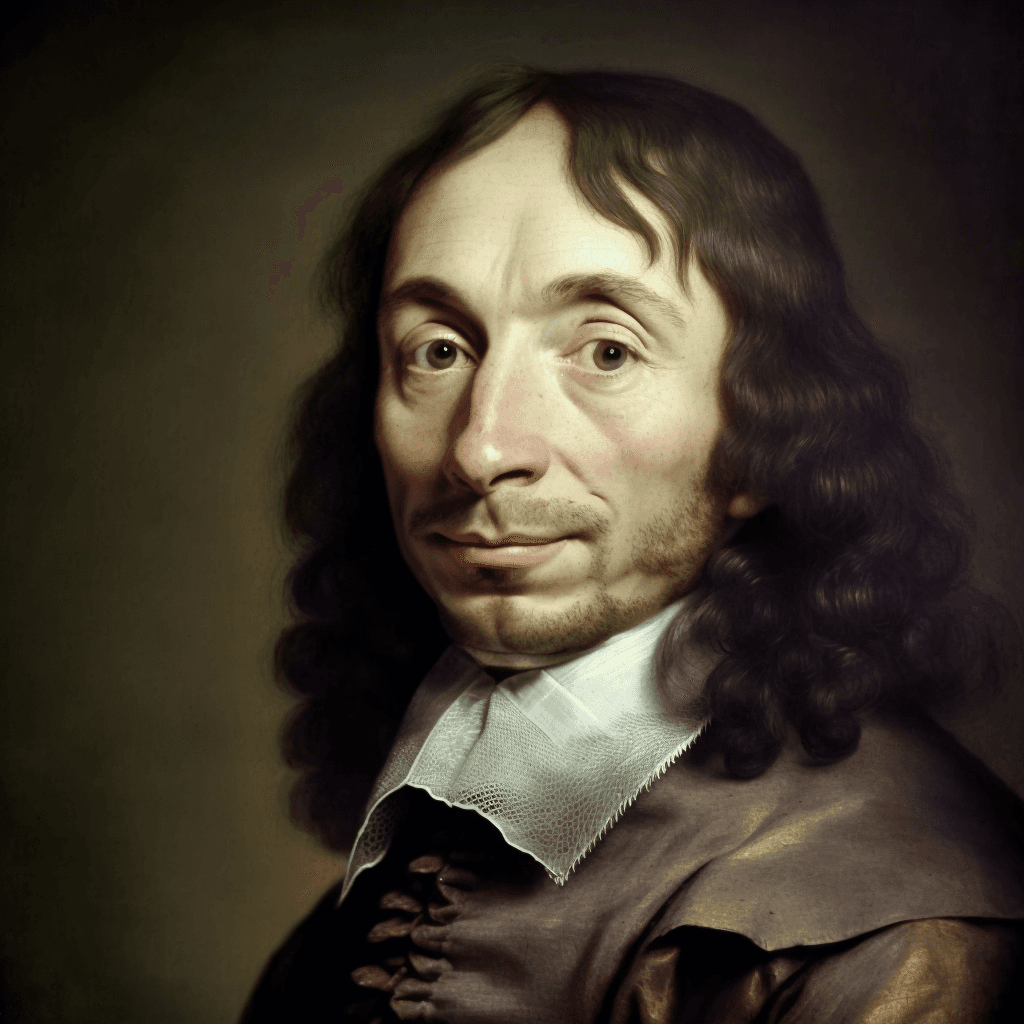
1623–1662
Mathematician • Physicist • Thinker
This is a read-only educational profile. Chat, Council Mode, and AI features are not available for historical figures.
Blaise Pascal was born on 19 June 1623 in Clermont-Ferrand, Auvergne, and displayed extraordinary mathematical talent as a child, reportedly mastering Euclid independently when his father Etienne initially withheld geometry texts fearing premature abstraction. Etienne, a royal tax administrator and amateur mathematician, moved the family to Paris in 1631 and later to Rouen, where Blaise assisted with computational work that exposed him to arithmetic drudgery of revenue collection. Teenage contributions to projective geometry, including a treatise on conic sections, impressed Descartes and Mersenne's Parisian intellectual circle. The Pascal family practiced Jansenist-influenced Catholic piety, connecting Blaise early to Port-Royal's reform movement emphasizing grace, predestination, and moral rigor against Jesuit casuistry. Fragile health plagued him from youth: migraines, digestive weakness, and leg pain shaped a life of intense mental work punctuated by illness. His sister Jacqueline became a nun at Port-Royal, deepening family ties to theological controversy that would engulf Pascal in the 1650s. Parisian salons knew him as prodigy and conversational wit, yet he withdrew periodically from social life to pursue mathematics and spiritual reflection. Etienne's injury in a Paris coach accident led to medical consultations that indirectly connected Pascal to barometric experiments transforming physics. By his twenties Pascal had already shifted between pure mathematics, mechanical invention, and religious concern, a triangle of interests rare even among polymaths.
Assisting his father's tax duties, Pascal designed the Pascaline, an early mechanical calculator using geared wheels to perform addition and subtraction, one of the first calculating machines intended for administrative use. Several prototypes survive in museums, demonstrating craftsmanship though commercial success remained limited due to cost and repair difficulty. In the 1640s Pascal's experiments on vacuums and atmospheric pressure, conducted with brother-in-law Florin Perier, confirmed Evangelista Torricelli's hypothesis that mercury columns in tubes respond to air weight. The Puy-de-Dôme expedition measured lower mercury levels at altitude, providing dramatic empirical support for pneumatic theory against scholastic claims that nature abhorred vacuum. Pascal wrote treatises on the void, on equilibrium of liquids, and on communication of pressure—principles later generalized as Pascal's law in hydraulics, giving his name to the SI unit of pressure. Correspondence with Pierre de Fermat on problems of gambling and fair division laid foundations of mathematical probability, introducing expectation and combinatorial reasoning to questions of risk. These insights underpinned later insurance mathematics, statistics, and economics, though Pascal framed them initially as intellectual exercises rather than commercial tools. After a mystical experience on 23 November 1654, recorded on a sewn parchment known as the Memorial and discovered after his death, Pascal turned intensely toward theology. He wrote the Provincial Letters, eighteen pseudonymous attacks on Jesuit moral laxity, combining satire with theological argument in prose admired for French clarity and wit.
Pascal began the Pensées, fragmentary reflections on faith, doubt, and the human condition left unfinished at his death, organized posthumously into aphorisms on wretchedness and greatness of humanity. The wager argument— that rational choice under uncertainty favors living as if God exists—remains a staple of philosophy of religion courses, debated for logic and psychology alike. He defended Jansenism against royal and papal pressure, yet accepted church authority in final submissions, illustrating tension between conscience and obedience. Physically frail, he died in Paris on 19 August 1662 at thirty-nine from probable stomach cancer or tuberculosis complicated by exhaustion. Editors at Port-Royal prepared editions of Pensées that shaped reception for centuries. Scientifically, Pascal linked laboratory measurement with abstract mathematics; theologically, he explored paradox of hidden God and human finitude. Probability theory born from his Fermat correspondence underpins insurance, epidemiology, and modern statistics. French literature courses treat Provincial Letters and Pensées as masterpieces of prose style influencing Voltaire and later essayists. Few seventeenth-century thinkers so powerfully combined calculation, experiment, and meditation on mortality. Pascal remains cited in physics textbooks and theological anthologies simultaneously, a measure of breadth that defines the briefest yet most concentrated of Enlightenment precursors. Historians of science reconstruct his correspondence networks with Jesuit and Jansenist circles to explain how pneumatic experiments entered theological polemic. Collectors prize surviving Pascaline machines as milestones in computing history predating Babbage by centuries. Mathematicians teaching combinatorics still introduce Fermat-Pascal letters as origin texts for expectation and recursive probability. Philosophy seminars debate whether the wager argument persuades skeptics or merely clarifies stakes of belief under uncertainty. French literary prizes occasionally cite Pensées as model for concise moral essay writing addressed to skeptical readers. Science museums display replicas of his barometer experiments to demonstrate how seventeenth-century inquiry linked laboratory apparatus to theological argument about nature's void. Probability textbooks cite his triangle and correspondence when introducing binomial coefficients, linking devotional life to mathematics curricula students encounter long after his death. Theology faculties assign Provincial Letters as masterpieces of satirical prose that shaped French argument about grace, authority, and conscience. Readers and researchers continue to consult biographies, correspondence, and archival collections when reconstructing the context of these achievements.
Key moments across this figure's life and legacy
1623
Born in Auvergne and educated privately, showing early mathematical genius.
1642
Began work on a mechanical calculator while assisting his father's tax duties.
1648
Supported Perier's measurement showing lower mercury levels at higher elevation.
1654
Experienced a profound religious conversion recorded in the Memorial.
1662
Died in Paris after illness, leaving the Pensées unpublished in final form.
Landmarks that define this figure's contribution to history
Invented an early mechanical calculator to assist with tax and administrative arithmetic.
Demonstrated variations in barometric pressure with altitude, confirming vacuum phenomena.
Helped establish mathematical probability through analysis of games of chance.
Left unfinished theological fragments that became classics of French religious and philosophical prose.
How this figure shaped the world we inherit
Pascal linked laboratory measurement with abstract mathematics and introspective theology in ways that shaped multiple disciplines. Probability theory born from his correspondence underpins insurance, economics, and modern statistics. His defense of faith amid uncertainty influenced religious thought, while his experiments on pressure helped establish classical physics. Few seventeenth-century thinkers so powerfully combined calculation, experiment, and meditation on human finitude.
Explore more profiles from the same era or field
Curated educational resources for further study
Discover historical art and educational content on our media channels