Infinite Universe Cosmology
Argued that the cosmos has no center and contains countless worlds, extending Copernican ideas.
Discover
Explore influential historical figures from science, philosophy, leadership, art, and culture.
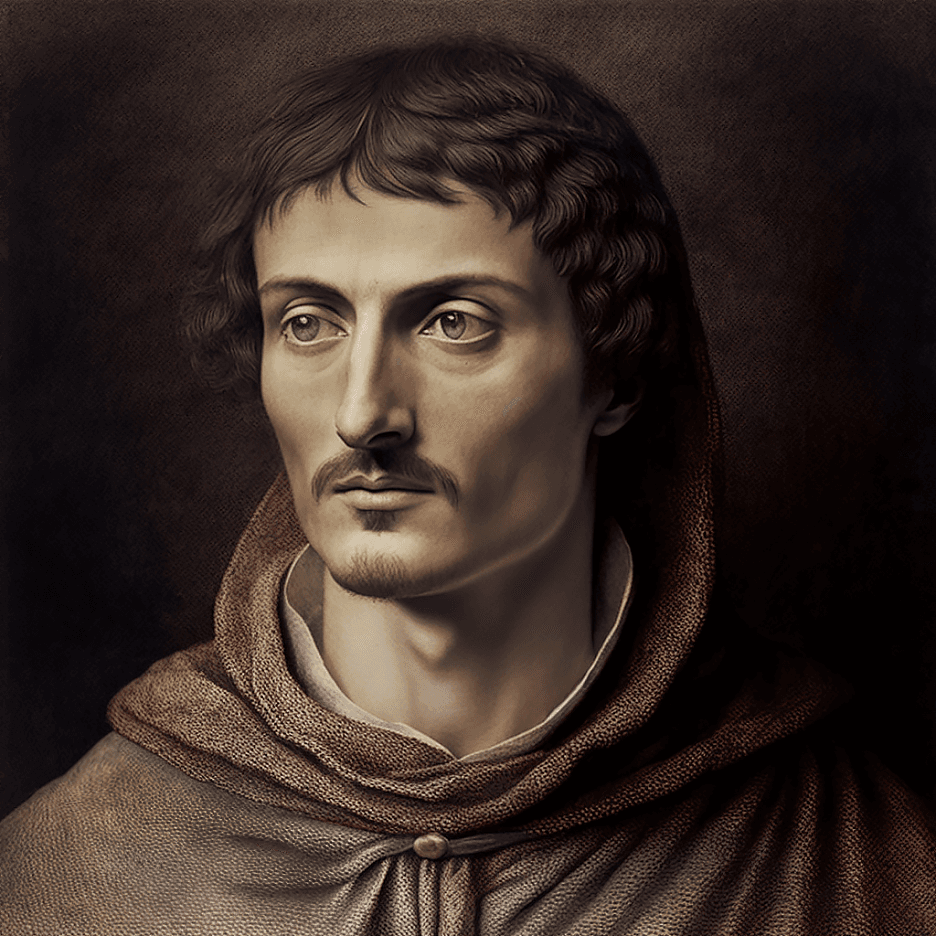
1548–1600
Philosopher • Cosmologist • Free Thinker
This is a read-only educational profile. Chat, Council Mode, and AI features are not available for historical figures.
Giordano Bruno was born Filippo Bruno in 1548 in Nola, near Naples, in the Kingdom of Naples, where he entered the Dominican order as a teenager, taking the name Giordano. He proved a brilliant and restless student of memory arts, Aristotle, and Neoplatonism, but his taste for heterodox opinions—including doubts about Marian doctrine and the veneration of saints—drew scrutiny from superiors. Accused of heresy, he fled his convent in 1576 and began fifteen years of wandering through Italy, Switzerland, France, England, and Germany, surviving by teaching mnemonic systems and debating university faculties. In England he lodged with the French ambassador and wrote Italian dialogues such as La Cena de le Ceneri and De l'infinito, universe e mondi, arguing that the cosmos contains innumerable worlds and that divinity imbues nature rather than residing in distant throne rooms alone.
Bruno's cosmology drew on Copernicus yet went further, rejecting a finite crystalline sphere and proposing an infinite universe without center, where stars might be suns circled by their own planets. He viewed matter as animated and eternal in ways that collided with orthodox creation doctrine, and his penchant for satire and personal quarrels made enemies as easily as admirers. He returned to Italy—a fatal miscalculation—in 1592, when Venetian nobleman Giovanni Mocenigo denounced him to the Inquisition. Bruno was arrested, extradited to Rome, and tried over seven years for heresy, including denial of transubstantiation and defense of metempsychosis. He refused to recant fully, insisting that his cosmological views were philosophical rather than theological, a distinction the tribunal rejected.
On 17 February 1600 authorities burned Bruno at the stake in Rome's Campo de' Fiori after he was stripped, gagged, and driven through the city as an impenitent heretic. His ashes were scattered to prevent relic veneration. Later Enlightenment writers cast him as a martyr for science, though historians note that his trial centered on theological heresy more than astronomy alone. A monument now stands in Campo de' Fiori where flowers appear each anniversary. Bruno's infinite universe anticipated aspects of modern cosmology while his death symbolized the price of intellectual defiance in Counter-Reformation Europe. He remains a contested figure—visionary philosopher, difficult provocateur, and cautionary example of how state-church power could extinguish dissent.
Key moments across this figure's life and legacy
1548
Raised near Naples before joining the Dominican order as Giordano Bruno.
1576
Escaped prosecution and began years of exile across Europe.
1584
Defended an infinite universe and plurality of worlds in London.
1592
Denounced to the Inquisition and extradited to Rome for trial.
1600
Executed in Campo de' Fiori on 17 February for persistent heresy.
Landmarks that define this figure's contribution to history
Argued that the cosmos has no center and contains countless worlds, extending Copernican ideas.
Developed mnemonic systems that linked philosophy to theatrical memory techniques.
Wrote vivid dialogues in the vernacular challenging Aristotelian and scholastic orthodoxy.
Refused recantation and was burned at the stake in Rome in 1600 for doctrinal crimes.
How this figure shaped the world we inherit
Bruno's cosmological speculations and his execution for heresy became emblematic of the conflict between free inquiry and religious authority in early modern Europe. His story continues to frame debates over censorship, scientific freedom, and the complex relationship between philosophy and faith.
Explore more profiles from the same era or field
Curated educational resources for further study
Discover historical art and educational content on our media channels