First Law of Planetary Motion
Kepler showed that planets travel in elliptical orbits with the Sun at one focus, overturning centuries of circular models.
Discover
Explore influential historical figures from science, philosophy, leadership, art, and culture.
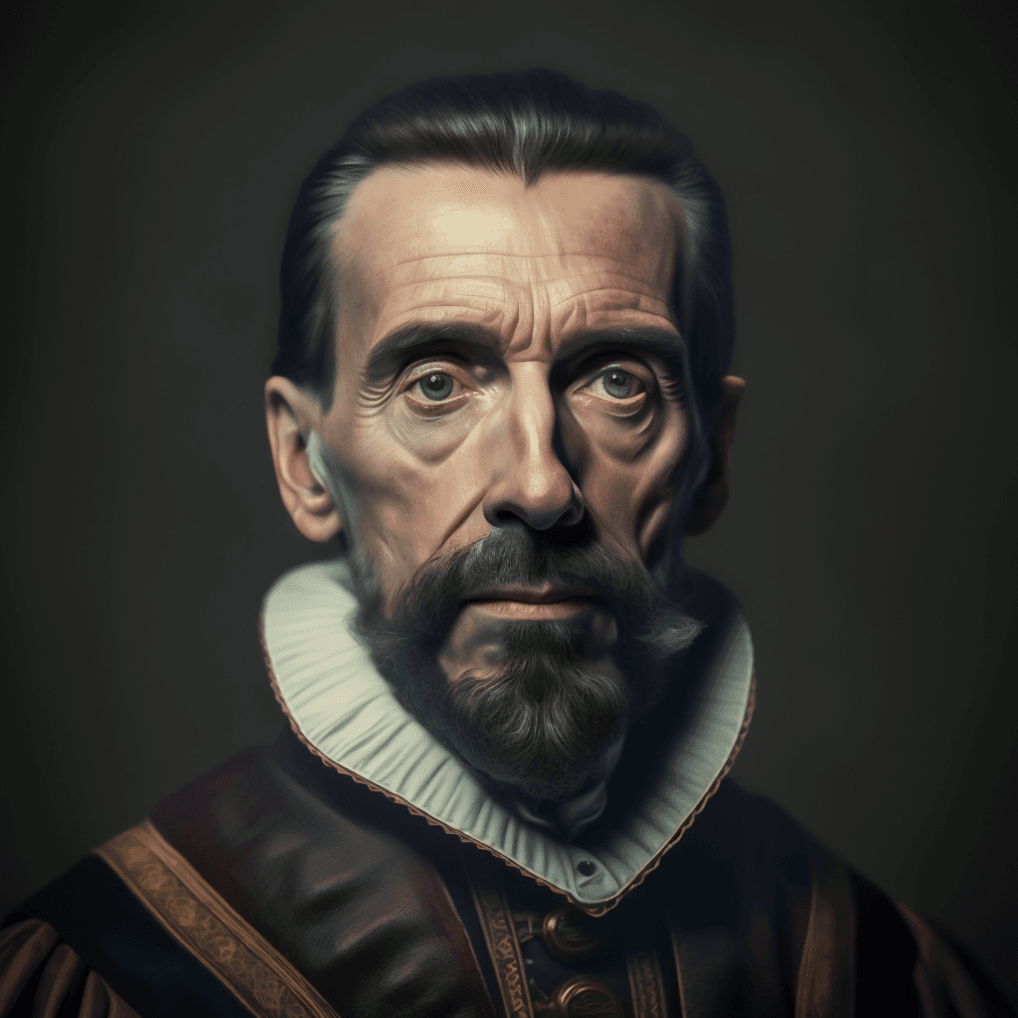
1571–1630
Astronomer • Mathematician • Laws of Planetary Motion
This is a read-only educational profile. Chat, Council Mode, and AI features are not available for historical figures.
Johannes Kepler was born in 1571 in Weil der Stadt in the Holy Roman Empire. Raised in a modest Lutheran family, he studied theology and mathematics at Tübingen, where he became a convinced Copernican. Poor health and financial strain marked much of his life, yet he pursued astronomy with a conviction that cosmic order reflected divine geometry.
After working with Tycho Brahe in Prague, Kepler inherited the finest pre-telescopic observational records in Europe. From Tycho's data on Mars he derived that planets move in ellipses with the Sun at one focus, sweep equal areas in equal times, and obey a precise relation between orbital period and distance. Published between 1609 and 1619, these laws gave mathematical form to heliocentrism and prepared the ground for Newtonian mechanics.
Kepler also calculated improved tables for navigation and astrology, studied optics, and defended his mother during a witchcraft trial. His blend of rigorous calculation, metaphysical speculation, and empirical restraint made him a central figure in the Scientific Revolution.
Key moments across this figure's life and legacy
1571
Kepler was born prematurely in Weil der Stadt; childhood smallpox left him with weakened vision but did not stop his scholarly rise.
1600
He joined the imperial mathematician in Prague and gained access to meticulous naked-eye observations of Mars and other bodies.
1609
He published his first two laws of planetary motion after years of laborious calculation to fit Mars to an ellipse.
1619
Kepler announced the third planetary law and explored musical and geometric harmonies he believed governed the cosmos.
1630
He died while traveling to collect overdue pay from the imperial court, leaving manuscripts that influenced Newton and later astronomers.
Landmarks that define this figure's contribution to history
Kepler showed that planets travel in elliptical orbits with the Sun at one focus, overturning centuries of circular models.
He demonstrated that a line from a planet to the Sun sweeps equal areas in equal intervals of time, describing changing orbital speed.
He established that the square of a planet's orbital period is proportional to the cube of its mean distance from the Sun.
His astronomical tables, completed in 1627, offered far more accurate planetary predictions than earlier ephemerides.
How this figure shaped the world we inherit
Kepler's laws transformed astronomy from descriptive geometry into a physics-ready description of motion. By proving that empirical data could overrule ancient authority, he helped establish the method of modern science and supplied Newton with the planetary framework later unified under universal gravitation.
Explore more profiles from the same era or field
Curated educational resources for further study
Discover historical art and educational content on our media channels